What is cord blood banking?
Cord blood (short for umbilical cord blood) is the blood that remains in the umbilical cord and placenta post-delivery. At or near term, there is a maternal–fetal transfer of cells to boost the immune systems of both the mother and baby in preparation for labor. This makes cord blood at the time of delivery a rich source of stem cells and other cells of the immune system. Cord blood banking is the process of collecting the cord blood and extracting and cryogenically freezing its stem cells and other cells of the immune system for potential future medical use.
As cord blood is inter-related to cord blood banking, it is often a catch-all term used for the various cells that are stored. It may be surprising for some parents to learn that stored cord blood contains little of what people think of as "blood," as the red blood cells (RBCs) can actually be detrimental to a cord blood treatment. (As we'll discuss later, one of the chief goals of cord blood processing is to greatly reduce the volume of red blood cells in any cord blood collection.)
In Europe and other parts of the world, cord blood banking is more often referred to as stem cell banking. As banking cord blood is designed more to collect the blood-forming stem cells and not the actual blood cells themselves, this term may be more appropriate.
There was a time before the 1990s when the umbilical cord and its blood were considered medical waste. Today, parents bank or store their baby's umbilical cord blood because the stem cells it contains are currently utilized or show promise in the treatment of life-threatening and debilitating diseases.
Luckily for expectant parents, cord blood can be easily collected at the baby’s birth via the umbilical cord with no harm to the mother or baby. This is why pregnancy is a great time to plan to collect and bank a baby's cord blood.
Cord blood in disease treatment
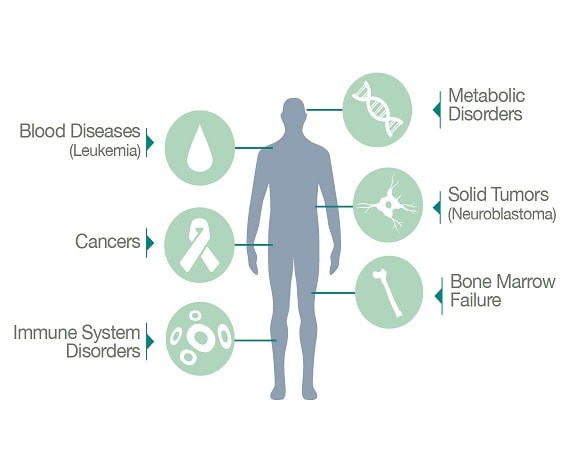 Cord blood is currently approved to treat nearly 80 diseases and conditions of the blood and immune system.
Cord blood has an abundance of stem cells and immune system cells, and the medical uses of these cells has been expanding at a rapid pace. As these cells help the body re-generate tissues and systems, cord blood is often referred to as a regenerative medicine.
Cord blood is currently being used to treat nearly 80 diseases and conditions, and allogeneic cord blood transplants have been performed more than 60,000 times around the globe to treat cancers (including lymphoma and leukemia), anemias, inherited metabolic disorders and some solid tumors and orthopedic repair. Researchers are also exploring how cord blood has the ability to cross the blood–brain barrier and reduce inflammation, which may be instrumental in treating conditions that have been untreatable up to this point. The most exciting of these are autism, cerebral palsy and Alzheimer's.
At present, the odds of undergoing any stem cell transplant by age 70 stands at one in 217, but with the continued advancement of cord blood and related stem and immune cell research, the likelihood of utilizing the preserved cord blood for disease treatment will continue to grow. Read more about cord blood as a regenerative medicine here.
Benefits for the entire family
Because the body's immune system is designed to find and get rid of what it believes to be outside contaminants, stem cells and other cells of the immune system cannot be transfused into just anyone. For stem cell transfusions of any type, the body's immune system can mistakenly start attacking the patient's own body. This is known as graft-versus-host disease (GvHD) and is a big problem post-transplant. GvHD can be isolated and minimal, but it can also be acute, chronic and even deadly.
To prevent graft-versus-host disease and help ensure engraftment, the stem cells being transfused need to match the cells of the patient completely or to a certain degree (depending on what is being treated). Cord blood taken from a baby's umbilical cord is always a perfect match for the baby.(1) In addition, immediate family members are more likely to also be a match for the banked cord blood. Siblings have a 25 percent chance of being a perfect match and a 50 percent chance of being a partial match. Parents, who each provide half the markers used in matching, have a 100% chance of being a partial match. Even aunts, uncles, grandparents and other extended family members have a higher probability of being a match and could possibly benefit from the banked cord blood. Read more reasons why you should bank cord blood.
How much does cord blood banking cost?
As most parents would like to bank their babies' cord blood to help safeguard their families, it is often the cost of cord blood banking that is the one reason why they do not. Most cord blood banks have an upfront fee for collecting, processing and cryo-preserving the cord blood that runs between $1,000 and $2,000. This upfront fee often also includes the price of the kit provided to collect and safely transport the cord blood, the medical courier service used to expedite the kit's safe shipment, the testing of the mother's blood for any infectious diseases, the testing of the baby's blood for any contamination, and the cost of the first full year of storage. There is then often a yearly fee on the baby's birthday for continued storage that runs around $100 to $200 a year.
At Cryo-Cell, we strive to give all parents the chance to store their babies’ umbilical cord blood for the future health of their families. We offer special discounts and offers for multiple births, returning customers, referrals, military families, medical professionals, long-term, pre-paid storage plans and more. In addition, we have in-house financing options that start for as little as a few dollars a day to keep cord blood banking in everyone’s reach. See how much cord blood banking costs at Cryo-Cell here.
How does cord blood banking work?
While banking cord blood is a new experience for many parents, it is a simple one. After all, most mothers are worried about how the delivery will go and don’t want to also be worried about the details of collecting, processing and cryo-preserving their babies’s cord blood. Thankfully, the healthcare provider and the cord blood bank do most of the work. Here are the steps found in cord blood banking:
- The cord blood bank sends you a collection kit. Kits like ours just need to be stored at room temperature.
- The cord blood collection kit goes with the expectant parents to the delivery center.
- Upon admission, the mother’s blood is collected to be tested for any infectious diseases as mandated by federal regulations.
- Upon birth but before the placenta is delivered, the healthcare provider will clamp and cut the umbilical cord as normal.
- Remaining in the umbilical cord and placenta is approx. 40–120 milliliters of cord blood. The healthcare provider will extract the cord blood from the umbilical cord at no risk or harm to the baby or mother.
- The collection bag with the baby’s cord blood and the vials with the mother’s blood are placed back inside the collection kit.
- Parents call a toll-free number on the collection kit to have a medical courier—any time, 24 hours a day, seven days a week—arrange for its transportation to the cord blood bank.
This is a simplified version of the steps to cord blood banking. For a more detailed overview, you can read more about the steps to cord blood banking here.
Processing and cryo-preservation
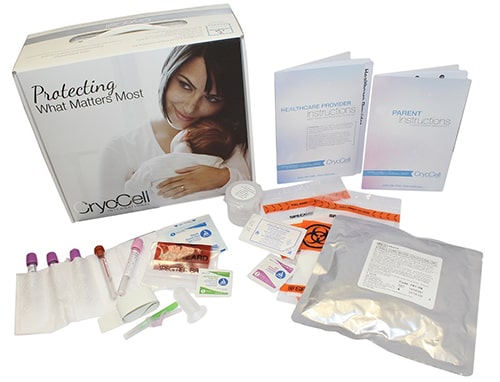 Banking starts with a cord blood and cord tissue collection kit
When the medical courier delivers the cord blood collection kit to the cord blood bank, it is quickly processed to ensure the continued viability of the stem cells and immune system cells found in the cord blood. Firstly, a sample of the cord blood is tested for microbiological contamination, and the mother’s blood is tested for infectious diseases. As these tests are being conducted, the cord blood is processed to reduce the number of red blood cells and its total volume and isolate the stem cells and immune cells.
There are a number of different processing methods out there for a cord blood bank to use, and the processing method can ultimately affect the purity of the final product, which we'll explain in a minute. Once the stem and immune system cells have been isolated and extracted from the plasma and red blood cell, they are mixed with a cryo-protectant and stored in a cryo-bag. We over-wrap our bags for added protection and use a technique called "controlled-rate freezing" to prepare the cells for long-term storage. The over-wrapped cryo-bag is housed in a protective metal cassette and placed in vapor-phase liquid nitrogen freezer for long-term preservation.
As noted, there are different ways to process cord blood, and although the type of processing method doesn't always enter the conversation on cord blood banking, it is a big part of the purity of any cord blood collection. Red blood cells can have a negative impact on a cord blood transfusion. In addition, there is a certain number of stem cells that need to be present in order for the cord blood to be effective in disease treatment. Each processing method has the ability to better reduce the number of RBCs and capture more stem cells. Some processing methods like AutoXpress and Sepax are automated to ensure a level of consistency across all collections. HES is preferred by some banks because it was the original processing method used by most banks and it has a proven track record. You can read more about the different cord blood processing methods here.
Premium cord blood processing: PrepaCyte®-CB
In terms of performance, our PrepaCyte-CB processing method has taken the lead. PrepaCyte-CB greatly improves on parents' returns on investment because it yields the highest number of stem cells while showing the greatest reduction in red blood cells.1–4 Clinical transplant data show that cord blood processed with PrepaCyte-CB engrafts more quickly than other processing methods.7 This means patients may start feeling better more quickly, may spend less time in the hospital and are less likely to suffer from an infection. The ability to get better more quickly and a reduced chance of infection can prove vital in certain cases. Learn more about PrepaCyte®-CB here.
What if you want to delay cord clamping?
The parents who make the decision to store their baby’s cord blood and cord tissue are thinking ahead, wanting to do right from the start (even before the start), and taking steps to do whatever they can to protect their baby down the road. Today, many conscientious parents are also considering delayed cord clamping (DCC), a practice in which the umbilical cord is not clamped immediately but rather after it continues to pulse for an average of 30 seconds to 180 seconds. Many parents don’t realize that they can delay the clamping of the cord and still bank their baby’s cord blood. As noted early, our premium processing method, PrepaCyte-CB, is able to capture more immune system cells and reduce the greatest number of red blood cell contaminants. This makes it go hand in hand with delayed cord clamping because it is not as affected by volume, effectively making up for the smaller quantity with a superior quality. You can read more about delayed cord clamping vs. cord blood banking here.
What's in cord blood?
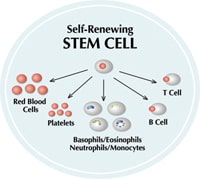 A stem cell has the potential to become one of many different cells.
Banked cord blood is most abundant in white blood cells and stem cells. While a lot of attention is paid to the stem cells, there are approximately 10 times more total nucleated cells (TNCs) than stem cells in any cord blood collection. TNCs are basically white blood cells, or leukocytes; they are the cells of the immune system that protect the body. Despite stem cells comprising one-tenth of most collections, cord blood is still considered a rich source of hematopoietic (he-mah-toe-po-ee-tic) stem cells (HSCs). HSCs are often designated by the marker CD34+. Hematopoietic stem cells can become two categories of cells: myeloid and lymphoid cells. Myeloid cells go on to form your red blood cells, platelets, and other cells of the blood. Lymphoid cells go on to become the B cells and T cells and are the basis for the immune system. Cord blood also contains mesenchymal (meh-sen-ki-mal) stem cells (MSCs), but they are much more abundant in cord tissue, which we will discuss in a minute.
In addition to the stem cells, researchers are discovering specific uses for the other types of cells in the treatment of certain conditions. Cord blood Treg cells hold potential for preventing graft-versus-host disease in stem cell transplantations and ameliorating the effects of autoimmune diseases such as diabetes, rheumatoid arthritis and multiple sclerosis. Cord blood natural killer cells also hold future potential. These cells have been programmed to target specific cancers and tumors in clinical trials. This could make them exceptionally strong candidates for chronic or treatment-resistant cases of cancer.
Another way scientists are working with stem cells is through expansion technologies that spur replication of the cord blood stem cells. If proven effective and approved by the U.S. Food and Drug Administration, these expansion technologies will allow scientists to culture many stem cells from a small sample. This could provide doctors and researchers with enough stem cells to treat multiple family members with one cord blood collection or provide the baby with multiple treatments over time. To better prepare for the day when these expansion technologies are more easily accessible, some cord blood banks have begun to separate their cord blood collections into separate compartments, which can easily be detached from the rest of the collection and used independently. You can learn more about Cryo-Cell's five-chambered storage bag here.
So how does cord blood compare to cord tissue?
Cord blood contains mesenchymal stem cells but is much more abundant in hematopoietic stem cells. Cord tissue, on the other hand, contains some hematopoietic stem cells but is much richer in mesenchymal stem cells. Cord tissue, or Wharton’s jelly, is the protective layer that covers the umbilical cord's vein and other vessels. Its MSCs can become a host of cells including those found in the nervous system, sensory organs, circulatory tissues, skin, bone, cartilage, and more. MSCs are currently undergoing clinical trials for sports injuries, heart and kidney disease, ALS, wound healing and autoimmune disease. As with cord blood, cord tissue is easily collected at the type of birth and holds great potential in regenerative medicine. Learn more about cord tissue banking here.
Alternatives to cord blood banking
Bone marrow and other sources
If someone doesn't have cord blood stored, they will have to rely on stem cells from another source. For that, we can go back to the history of cord blood, which really begins with bone marrow. Bone marrow contains similar although less effective and possibly tainted versions of the same stem cells abundant in cord blood. Scientists performed the first bone marrow stem cell transplant in 1956 between identical twins. It resulted in the complete remission of the one twin’s leukemia.
Because of the invasive procedure required to obtain the bone marrow, scientist continued to look for a better source, which eventually lead to the discovery of similar stem cells in cord blood in 1978. Cord blood was used in its first transplant in 1988, and cord blood has since been shown to be more advantageous than other means of acquiring similar stem cells and immune system cells. This is because umbilical cord blood can be considered naïve and immature compared to other sources. Cord blood has not been exposed to disease or environmental pollutants, and it is more accepting of foreign cells. In this case, inexperience makes it stronger.
As noted earlier, with better matching, there is a greater chance of success and less risk of graft-versus-host disease (GvHD) in any stem cell transplant. With cord blood, the baby's own cells are always a perfect match and share little risk. When using cord blood across identical twins, there is also a very low chance of GvHD although mutations and biological changes caused by epigenetic factors can occur. Other blood-related family members have a 35%–45% chance of GvHD, and unrelated persons have a 60%–80% chance of suffering from GvHD.
Bone marrow and similar sources often requires an invasive, surgical procedure and one's own stem cells may already have become diseased, which means the patient will have to find matching stem cells from another family member or unrelated donor. This will increase the risk of GvHD. In addition, finding an unrelated matched donor can be difficult, and once a match is ascertained, it may take valuable weeks, even months, to retrieve. Learn more about why cord blood is preferred to the next best source, bone marrow.
Public cord blood banks
The first cord blood banks were private cord blood banks. In fact, Cryo-Cell is the world’s first private cord blood bank. It wasn’t until later that the government realized the need to preserve cord blood for research and public welfare. As a result, 31 states have adopted a law or have a piece of pending legislation that requires or encourages OBGYNs to educate expectant parents about cord blood banking and many states now have publicly held cord blood banks. As a result, parents have the option of banking their baby's cord blood privately for the exclusive use of the child and the rest of the family or donating the cord blood to a public bank so that it can be used in research or by any patient who is a match and in need.
If you're looking to attain cord blood from a public bank, be aware that matched cord blood, as with bone marrow, can be difficult to obtain through a public cord blood bank. Once a match is ascertained, it may take valuable weeks, even months, to retrieve the match, and the cost of acquiring the cord blood from a public bank can be upwards of $40,000. When the newborn’s umbilical cord blood is banked privately, they can be retrieved quickly, and since the parents own the cord blood, banks can perform the retrieval free of charge. Learn more about public versus private cord blood banking here.
Frequently asked questions
Banking cord blood is a new type of medical protection, and there are a lot of questions that parents may want to ask. The Parent’s Guide to Cord Blood organization even has questions it believes all parents should ask their cord blood banks. We have answers to these and other frequently asked cord blood questions in our FAQs. If you can’t find the answer for which you are looking, please feel free to engage one of our cord blood educators through the website's chat interface.
Want to learn more? We are here to answer any question you may have and can send you any information about cord blood banking that you need.
2. In order to preserve more types and quantity of umbilical cord stem cells and to maximize possible future health options, Cryo-Cell’s umbilical cord tissue service provides expectant families with the opportunity to cryogenically store their newborn’s umbilical cord tissue cells contained within substantially intact cord tissue. Should umbilical cord tissue cells be considered for potential utilization in a future therapeutic application, further laboratory processing will be necessary. Regarding umbilical cord tissue, all private blood banks’ activities for New York State residents are limited to collection, processing, and long-term storage of umbilical cord tissue stem cells. The possession of a New York State license for such collection, processing and long-term storage does not indicate approval or endorsement of possible future uses or future suitability of these cells.